
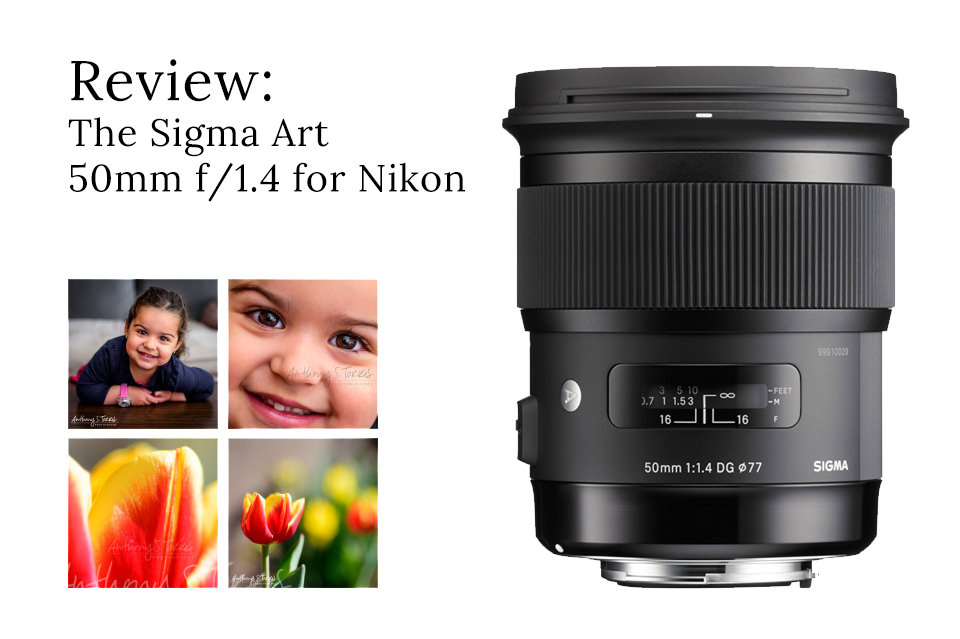
I was a little skeptical of all the raves for the Sigma 50mm f/1.4 DG HSM Art when I was checking my usual photography groups on Facebook, even with examples posted. F/1.4 is a tough sell for me given the typical steep jump in price even from an f/1.8 lens. I understand the benefit, have rented lenses like the Nikon 85mm f/1.4, but it was hard to justify that one as a keep-on-me lens for what I shoot. Here's why:
That Depth of Field for an F/1.4 Lens
While the creaminess of the bokeh at f/1.4 is pretty awesome to look at, that depth of field has its cons too. The biggest thing is what I photograph most: active children and families. If you haven't used an f/1.4 lens before, you will be really surprised at how little depth of field you have to work with on closer shots. Seriously. If you aren't perfectly still, on a tripod, or have a perfectly still subject, even being a hair off is enough to lose the eyes in focus and put their hair or nose in focus instead.
If your subjects are farther away, you have a little leeway. Still, the point of having this lens for a portrait is to take advantage of getting those eyes in focus and using the f/1.4 lens as an f/1.4 lens. If you're like me and need to shoot stopped down to get more in focus, it kind of defeats the purpose. This goes for all of these kinds of lenses, not just the Sigma. Consider what you're photographing.
It's a "Boring" Focal Length
This will annoy some photographers. For my own work, the 50mm just seems... boring. It's pretty much what I see with my eyes already, and I like to photograph something beyond that. I know how my 85mm or my 135mm or my 200mm will look in my head, and as such, the 50mm wasn't as exciting to me. Before you lose your mind over how much you love the 50mm, this is my personal preference.
Now here's the other thing. Are you working in a space where you can't afford the luxury of a longer lens, especially ones like a 70-200mm where the minimum focus distance is around six feet? That's a huge reason to consider this lens. I think if space is tight, this and a 24mm or 35mm would be a good combination.
Weight and Feel
A lot of my previous discussion is generic to that aperture and depth of field. Getting more specific to the Sigma Art: the first thing I noticed is the weight. I'm coming from an old Nikon 50mm f/1.8D. That's a simple little lens that got me started with my first DSLR. It was fine, it was slow, it was light. This lens has some girth to it. It's longer than I expected and feels like a tank.
For someone wanting to trim weight for carrying around, this isn't the way to go. Granted, it's fine for me, but compared to other prime lenses like my Nikon 85mm f/1.8, you feel it. That can be a pro for some though. It's sturdy, feels professional, and just feels good overall. Try it before buying if weight could be an issue. I would definitely recommend that.
Sharpness
With all the hype, I had to say I was impressed by the sharpness at f/1.4. If you're buying a wide open lens, it has to be good wide open. That's the point. Again, be warned with my earlier point on depth of field. If you aren't getting sharp images, make sure you're actually stable, your subject is stable, and you have a shutter speed to freeze things. They could all be at fault before you question your copy of the lens.
And let's be honest, sometimes as much as we strive for sharpness, in portraiture an ethereal feel is OK. You definitely get that feeling in the bokeh of this lens, but if you need subject sharpness, it's definitely there. Stopping down is what you'd expect: greater depth of field and greater sharpness along the way.
TL;DR: My Conclusions
When I get a lens like this, I put it on my camera for a while and force myself to use it as often as possible to make sure I understand it before any paying project. I removed my 24-70mm, my staple all-purpose lens, to keep this one as my go-to. F/1.4 is a really fun aperture to shoot at, but you may get a lot of out-of-focus photos if you're not careful. I find myself shooting f/1.8 or f/2 typically, which makes me think I could just use my other f/2.8 lens. May as well utilize a more open lens, especially for the bokeh.
For portraits, I still feel I get too close to a subject with a 50mm. If you're in a tight indoor area and 50mm is around the longest you can use, this lens is worth it. If I'm outdoors, I like longer lengths. But the 50mm can hold its own. You can do great full-length photos and closeups, and I would trust it for sharp, detailed, incredible photos. The preference of focal length will come down to how you shoot. If you're not sure, look up what lengths you're typically shooting at. If you're nearly always at 70mm, it may suit you to go 85mm instead.
Finding the Lens
If this review helped, Adorama is a trusted dealer for new and used gear. Want to try before buying? LensRentals is worth it for a lens at this price point.