
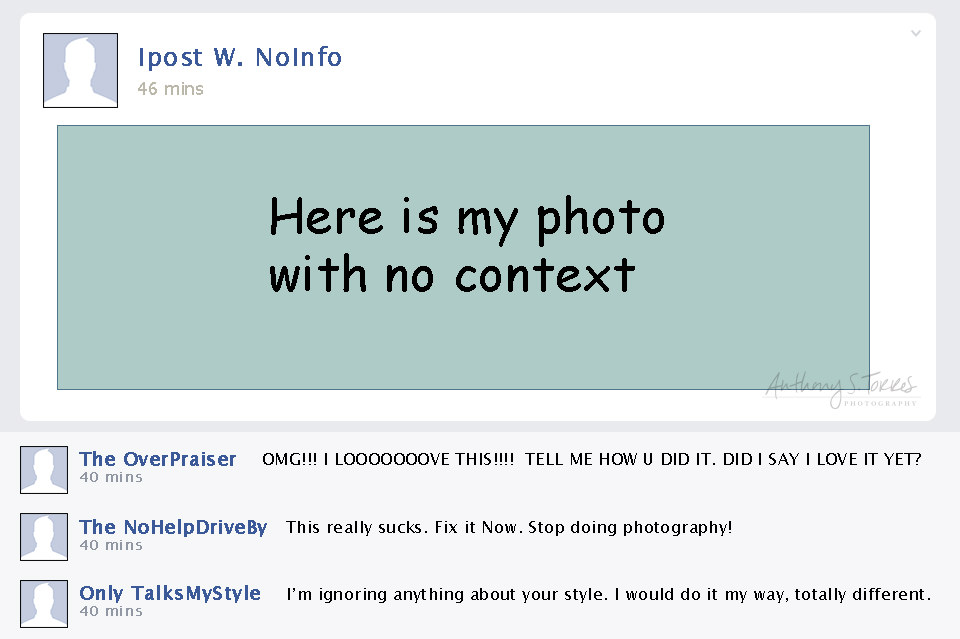
Lately I've noticed in many photography and art forums that the notion of critique has taken a hard turn, a turn where simply criticizing a shared image is the norm. Or a single short sentence of ultimate praise, which is almost equally as useless. Add in the standard follow-up comment of "You should learn how to take criticism" and we are watching the death of the critique. I believe it's time to restore the conversation.
The truth is two-sided. There is an expectation of both the presenter and the person commenting to do a little work in order to keep the conversation engaging, fruitful, and more like what you would experience in an art school setting. Many people haven't taken classes and aren't as familiar with this format, so here's my take on this lost art. Others may not fully agree, but I believe it's a starting point.
The Presenter
As the person seeking critique in a forum or group, it is your job to present us with some facts and context. Most importantly, your artwork is full of both "why" and "why not," and it's these decisions that shaped your final image. Before you share, write some notes that will tell us how you got there:
- Why did you choose this angle? Why did you exclude other angles?
- Why did you choose this depth of field over others?
- Why did you choose the color treatment, or the lack of color?
- What was the story you hoped the viewer would get from your image?
- What lighting did you use and how was it set up? Why did you choose it over other options?
This sets the tone. As a viewer, we can then see if we received the story you intended. Many of these questions will help you critique your own work even before you share it. You may find that you didn't consider other lighting or angles, and this may bring on more creative experiments all on its own.
The Critic
Even if a presenter fails to include context, there is still etiquette involved in your comments. If you want to help someone and believe your knowledge is worth sharing, then you must dedicate the time to crafting your response. If you don't have the time at that moment, it is not appropriate to "drive-by" comment, except to ask for more information from the presenter before you can actually speak to the work.
- Focus on the decisions. Ask the "why" and "why not" questions. Frame it as "had you considered."
- If there is anything you enjoy about the image, point that out and explain why. You may find it's exactly what the presenter intended, or you may find out it was a fluke. Both help the presenter moving forward.
- Make sure you are not simply imposing your style onto the presenter. "I would have made the lighting entirely soft and removed all that dramatic contrast" does not help them if they're going for drama. As a critic, you should be able to work within their style and see how you would adjust it if you were the one shooting.
The Conversation
What typically follows a quick image post and an even quicker comment is a defensive battle. Most of this gets better when both sides do the setup work described above.
- As a presenter, you may get some tough feedback. Do not expect all praise. Even if you get praise, ask for specifics about what they liked. You may find it's something you did not do on purpose but will consider going forward. Keep an open mind. There is no way you can account for all the thoughts and views others have on a given subject. Things may sting.
- As a critique-provider, the artist has every right to ask follow-up questions if your comments are unclear. They may also respond with "here's why I didn't choose that." This is not defensiveness. You do not have the right to make a rude and unclear comment and demand that it be accepted. I have had to explain myself in group critiques many times when someone brought something to my attention. It is part of the conversation. You must also accept the fact that your critique may be flawed. One opinion is not an absolute.
Social media and easy access to artists all over the world has tremendous benefits, but it has also pushed us to move too quickly. We share in hopes of getting praise and honest opinions, but fail to provide the information needed to start a real discussion. We also become rushed critics trying to prove our opinions matter, but not important enough to warrant real thought. The goal of all of this is to engage in meaningful conversations, ones that will help us all grow as artists.